How to write internal documentation: a writing and maintenance playbook for teams
Learn how to write internal documentation your team reads: doc types, six steps, a copy-ready template and a maintenance routine that keeps pages current.
Cortee turns short notes into scoped edits on the live page, so documentation stays current without a full rewrite.
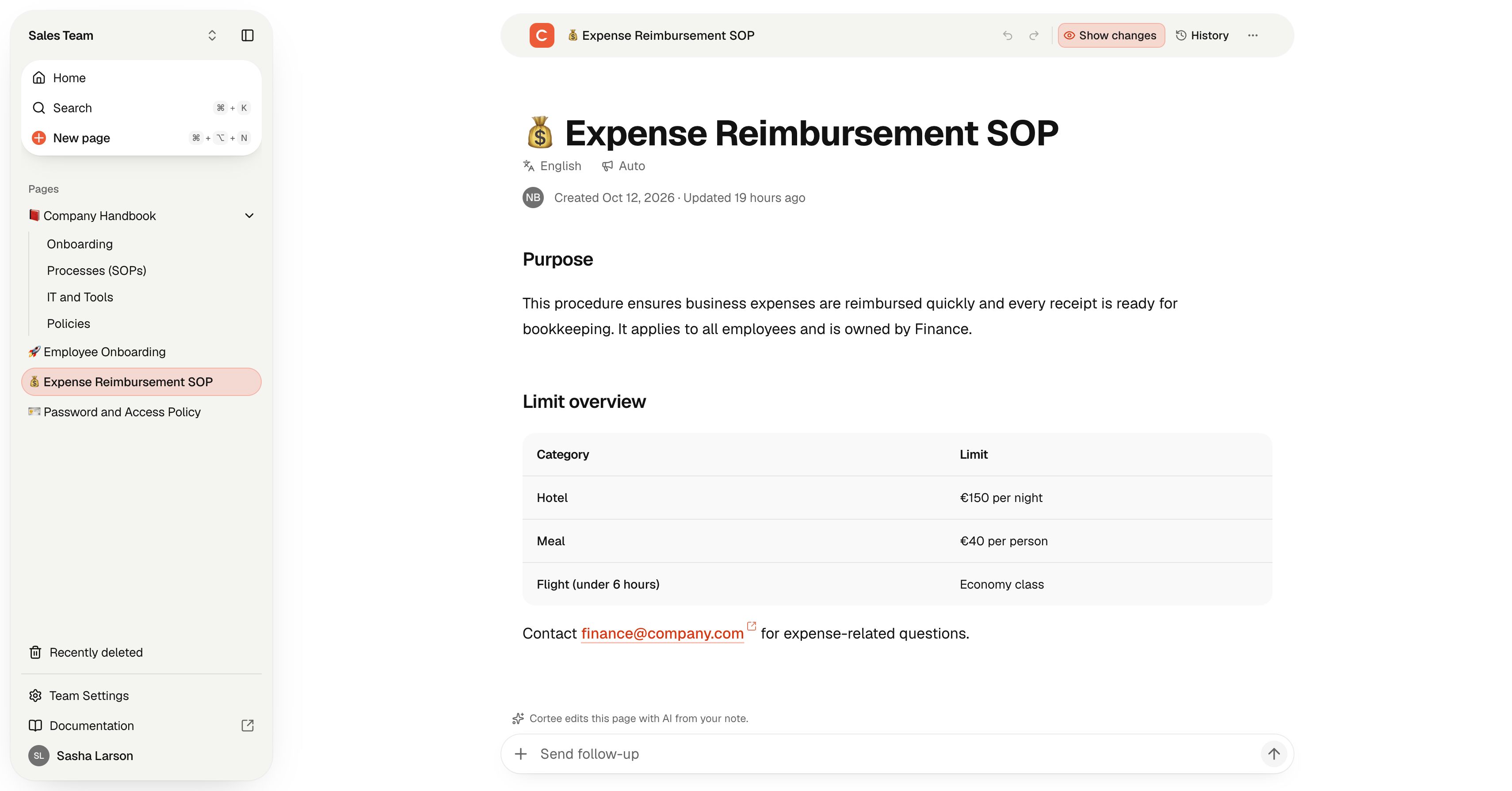
The team records a short note about what changed. Cortee converts that note into a focused edit on the live page.
The edit appears on the live page, so reviewers see the new wording in context immediately.
Cortee updates only the section that matches the note. Surrounding content remains unchanged.
Each paragraph can display the note that produced the wording, so reviewers can verify the source.
Cortee maintains a structure teams can continue to use: precise titles, stable outlines, and tables that update where they already sit.
Headings summarize the page in wording an editor would keep in a published document.
Structure updates in place, so teams avoid reformatting the page after every change.
Tables and lists are created and updated in their existing positions on the page.
The page remains readable after an AI edit because layout and tone stay consistent with the rest of the document.
After each update, pages remain readable, maintainable, and searchable, so team knowledge stays reliable between releases.
The page continues to read like documentation written and reviewed by your team.
Teams can revise the same page later without rebuilding it from a blank draft.
The relevant paragraph remains findable when someone needs the current answer.
Authors and source notes remain attached to the wording for later review.
See Cortee as a Notion AI alternative, GitBook alternative, or SharePoint alternative.
Notion, SharePoint, GitBook, and Microsoft are trademarks of their respective owners. Cortee is not connected with or endorsed by them.
Questions teams ask before adopting Cortee for production documentation.
1 Typical edit latency is currently under 1 second. Performance varies by prompt complexity, network, and system load.
Learn how to write internal documentation your team reads: doc types, six steps, a copy-ready template and a maintenance routine that keeps pages current.
Compare AI knowledge management tools on three checks: capture or search, who writes the fact, and whether people will record the change.
How to choose IT documentation software in October 2026: live updates from facts, reversible AI edits, privacy, and AI search once docs stay current.